
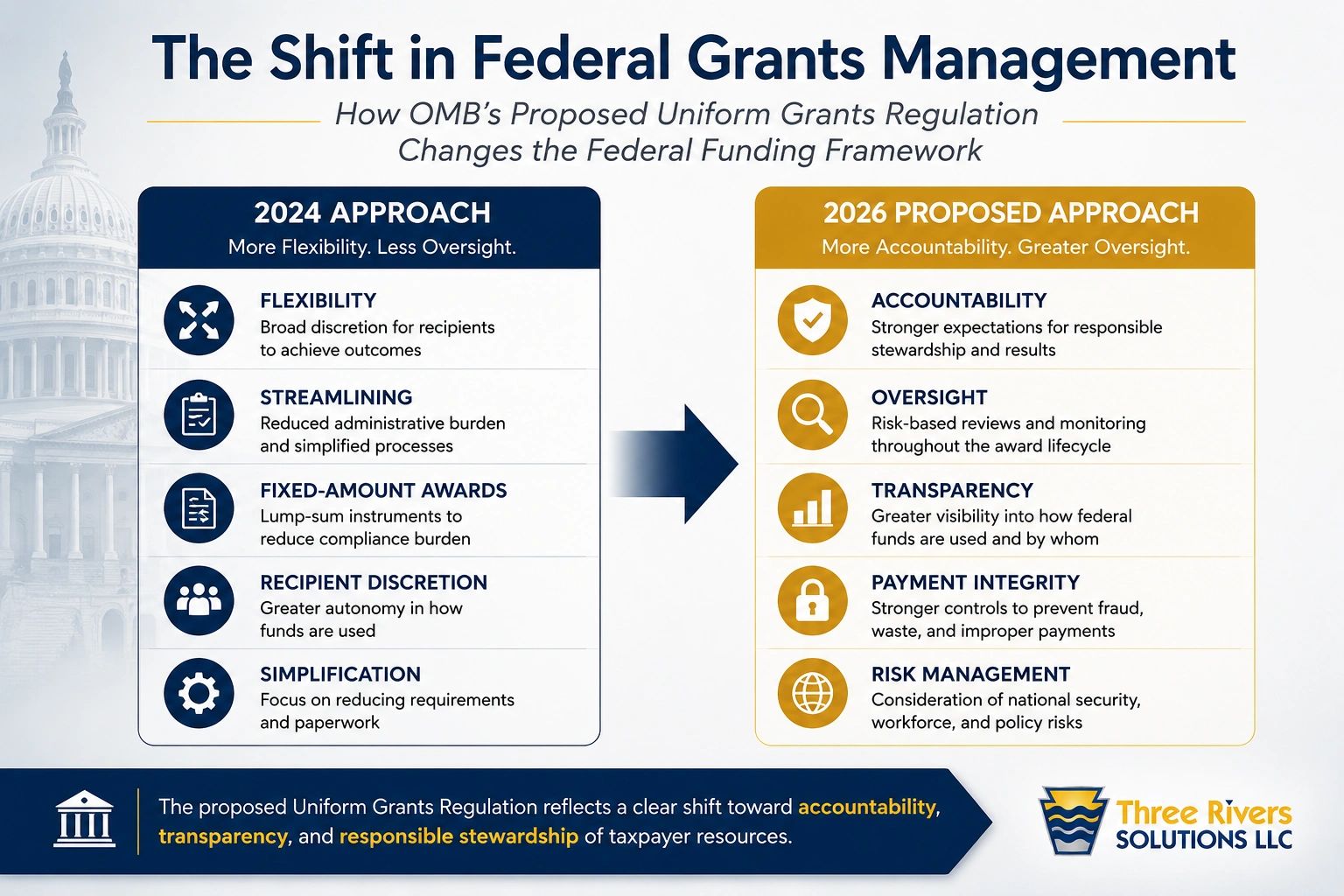
On May 29, 2026, the Office of Management and Budget proposed sweeping revisions to the regulations governing federal grants and cooperative agreements. While many observers have focused on the proposal's compliance implications, the more significant story may be what it reveals about the future direction of federal management, oversight, and accountability.
Federal grants and cooperative agreements touch nearly every community in America. They help fund roads and bridges, support public safety initiatives, advance scientific research, expand workforce development programs, strengthen local economies, and deliver essential services to millions of Americans.
Yet most organizations receiving federal funding spend little time thinking about the regulatory framework governing those funds until the rules change.
That may be about to happen.
Viewed in isolation, the proposal may appear to be a technical update to grants management requirements. Viewed in context, it offers insight into how the Trump Administration intends to strengthen oversight, improve accountability, and ensure federal funds are used in a manner consistent with national priorities.
For organizations that rely on federal funding, the proposal deserves close attention.
The Rule Behind Federal Financial Assistance
The Uniform Guidance, codified at Title 2 of the Code of Federal Regulations (2 CFR) Part 200, establishes the foundational rules governing most federal grants and cooperative agreements. It addresses everything from award administration and procurement standards to cost principles, audits, subrecipient oversight, and reporting requirements.
The Uniform Guidance affects a wide range of organizations, including state and local governments, transit agencies, school districts, universities, nonprofits, public authorities, research institutions, and other recipients of federal financial assistance.
Because it applies governmentwide, changes to these rules often have far-reaching implications that extend well beyond any single federal agency or program.
Notably, OMB's proposal seeks to formally establish Subtitle A as an OMB regulation rather than guidance, rebranding Part 200 as the Uniform Grants Regulation. While this may appear to be a technical distinction, it reflects a broader effort to reinforce the mandatory nature of these requirements and promote greater consistency across the federal government.
Why OMB Believes These Changes Are Necessary
To understand the proposal, it is important to understand the challenges it is attempting to address.
Federal agencies distribute hundreds of billions of dollars annually through thousands of grant programs. In many cases, those funds flow through multiple layers of recipients and subrecipients before reaching their final destination. As funding moves through those layers, agencies may have limited visibility into how funds are ultimately spent, who receives them, and whether program objectives are being achieved.
This challenge is particularly acute when federal funds pass through multiple layers of recipients, subrecipients, contractors, and program partners before reaching the communities they are intended to serve.
Supporters of the proposal argue that the federal government has a responsibility to ensure taxpayer dollars are spent efficiently, transparently, and in a manner consistent with statutory requirements and public policy objectives.
They point to longstanding challenges involving improper payments, inconsistent oversight, limited visibility into downstream spending, foreign influence concerns, fragmented reporting systems, and varying levels of accountability among recipients and subrecipients.
Viewed through that lens, many of the proposed reforms are designed to strengthen stewardship of federal funds rather than simply increase administrative requirements.
Five Signals Hidden in the Proposal
1. Federal Oversight Is Increasing
The era of "verify after funding" appears to be giving way to "verify before funding."
The proposal expands the factors agencies may consider when evaluating the risks associated with applicants and recipients.
In addition to traditional considerations such as financial stability, performance history, and audit findings, agencies would be directed to evaluate broader organizational relationships, foreign affiliations, and other publicly available information relevant to recipient risk.
Some organizations may view this increased scrutiny as burdensome. However, supporters argue that stronger front-end reviews can improve confidence that federal funds are awarded to organizations capable of delivering results and complying with federal requirements.
For recipients, the message is clear: strong governance, financial management, and organizational controls will become increasingly important.
2. Federal Funding Will Be More Closely Aligned with Agency Priorities
Federal spending and federal priorities are becoming more closely connected.
The proposal signals a desire for greater alignment between discretionary funding decisions and the priorities established by elected leadership.
Historically, grant reviews have relied heavily on technical evaluations and peer-review processes. Under the proposed rule, agencies would conduct additional senior leadership reviews of discretionary funding decisions to ensure awards align with agency objectives and broader national priorities.
Critics may view this as increased political involvement in funding decisions. Supporters argue that elected administrations should have the ability to ensure taxpayer dollars are advancing the priorities they were elected to pursue.
Regardless of perspective, the proposal makes clear that alignment with agency priorities will play an increasingly important role in the federal funding landscape.
3. Transparency Is Replacing Administrative Flexibility
OMB appears willing to trade flexibility for greater visibility into how federal funds are spent.
One of the most significant operational changes in the proposal is the elimination of fixed-amount subawards.
For years, many pass-through entities used fixed-amount subawards to simplify administration and reduce compliance burdens. OMB's proposal would replace that flexibility with greater financial transparency and visibility into how federal funds are ultimately spent.
The proposal also expands agency authority to impose conditions, adjust monitoring requirements, and take corrective action when concerns arise.
Taken together, these changes reflect a preference for transparency and accountability over administrative convenience.
4. Payment Integrity Is Becoming a Central Priority
Taxpayer dollars are receiving greater scrutiny.
OMB proposes expanded use of the Department of the Treasury's Do Not Pay tools, stronger documentation requirements supporting payment requests, and increased reporting expectations for recipients and pass-through entities.
The proposal also includes provisions requiring participation in the Department of Homeland Security's E-Verify program for employees and contractors performing work under covered federal awards.
These measures align with broader governmentwide efforts to reduce fraud, prevent improper payments, improve data quality, and strengthen public confidence in the stewardship of taxpayer resources.
Few taxpayers would object to efforts designed to ensure federal funds are going only to eligible recipients and are being used for their intended purposes.
5. National Security Considerations Are Expanding
Federal financial assistance is increasingly being viewed through a national security lens.
Several provisions address foreign collaborations, prohibited technologies, research security, and restrictions involving certain unmanned aircraft systems and other covered technologies.
The proposal also incorporates policy provisions related to diversity, equity, and inclusion programs, disparate-impact liability theories, and other administration priorities that have largely been addressed through executive actions and agency directives to date.
Whether one agrees with every provision or not, the broader direction is clear: federal financial assistance is increasingly being viewed through both a policy and national security lens.
This mirrors trends already visible in federal procurement, supply chain security, research security, and emerging technology governance.
What This Could Look Like in Practice
Consider a county government administering a federally funded workforce development program through several nonprofit partners.
Today, the county may already be responsible for monitoring subrecipients, tracking expenditures, and reporting program outcomes. Under the proposed framework, that same county could face additional expectations related to subrecipient reporting, documentation of expenditures, risk assessments, and ongoing monitoring activities.
The objective is not simply additional paperwork. The underlying goal is to provide federal agencies with greater visibility into how taxpayer dollars move through multiple layers of recipients and whether those funds are achieving their intended purpose.
This example illustrates why the proposal should be viewed as a management and accountability initiative rather than solely a grants compliance update.
Why This Matters Beyond the Grants Community
Many organizations will assume this proposal only affects grants administrators and compliance professionals.
That would be a mistake.
Federal financial assistance supports infrastructure projects, public safety programs, transportation systems, housing initiatives, workforce development efforts, research activities, public health programs, and economic development projects in communities across the country.
Changes to the rules governing those funds ultimately affect elected officials, agency leaders, nonprofit executives, researchers, consultants, contractors, and the communities that rely on federally funded programs.
The proposal should therefore be viewed as a public management issue, not simply a grants administration issue.
A Broader Trend in Federal Management
Perhaps the most interesting aspect of OMB's proposal is how it fits within a larger pattern of federal management reforms.
From a federal management perspective, the proposal should not be viewed as an isolated grants initiative. Similar themes are emerging across procurement reform, payment integrity efforts, artificial intelligence governance, and broader government modernization initiatives.
While procurement and financial assistance serve different legal purposes, both represent mechanisms through which the federal government deploys taxpayer resources to achieve public objectives.
Federal procurement reform efforts have sought to modernize acquisition while strengthening oversight of federal spending. Artificial intelligence governance initiatives have emphasized accountability, transparency, and risk management. Government efficiency initiatives have focused on improving visibility into how taxpayer resources are allocated and used.
In each case, policymakers are seeking greater visibility into how federal resources are used and stronger mechanisms for measuring accountability and performance.
The proposed Uniform Grants Regulation appears consistent with those broader themes.
Rather than viewing the proposal solely as a grants management update, it may be more useful to view it as part of a larger effort to strengthen the federal government's ability to oversee and manage taxpayer-funded programs.
Looking Ahead
The proposed rule remains subject to public comment and may change before it is finalized.
However, organizations should not dismiss it as a routine regulatory update.
If adopted substantially as proposed, the Uniform Grants Regulation would represent one of the most significant shifts in federal financial assistance management in recent years.
More importantly, it provides a clear signal of how the federal government intends to exercise stewardship over taxpayer dollars in the years ahead.
Whether one agrees with every provision in the proposal, the broader message from OMB is unmistakable: federal financial assistance is entering a period of heightened accountability.
Organizations that view the proposal solely through the lens of compliance may miss the larger story. The proposed Uniform Grants Regulation offers a glimpse into how the federal government intends to oversee taxpayer dollars in the years ahead.
For recipients of federal funding, understanding that shift will be just as important as understanding the rule itself.