
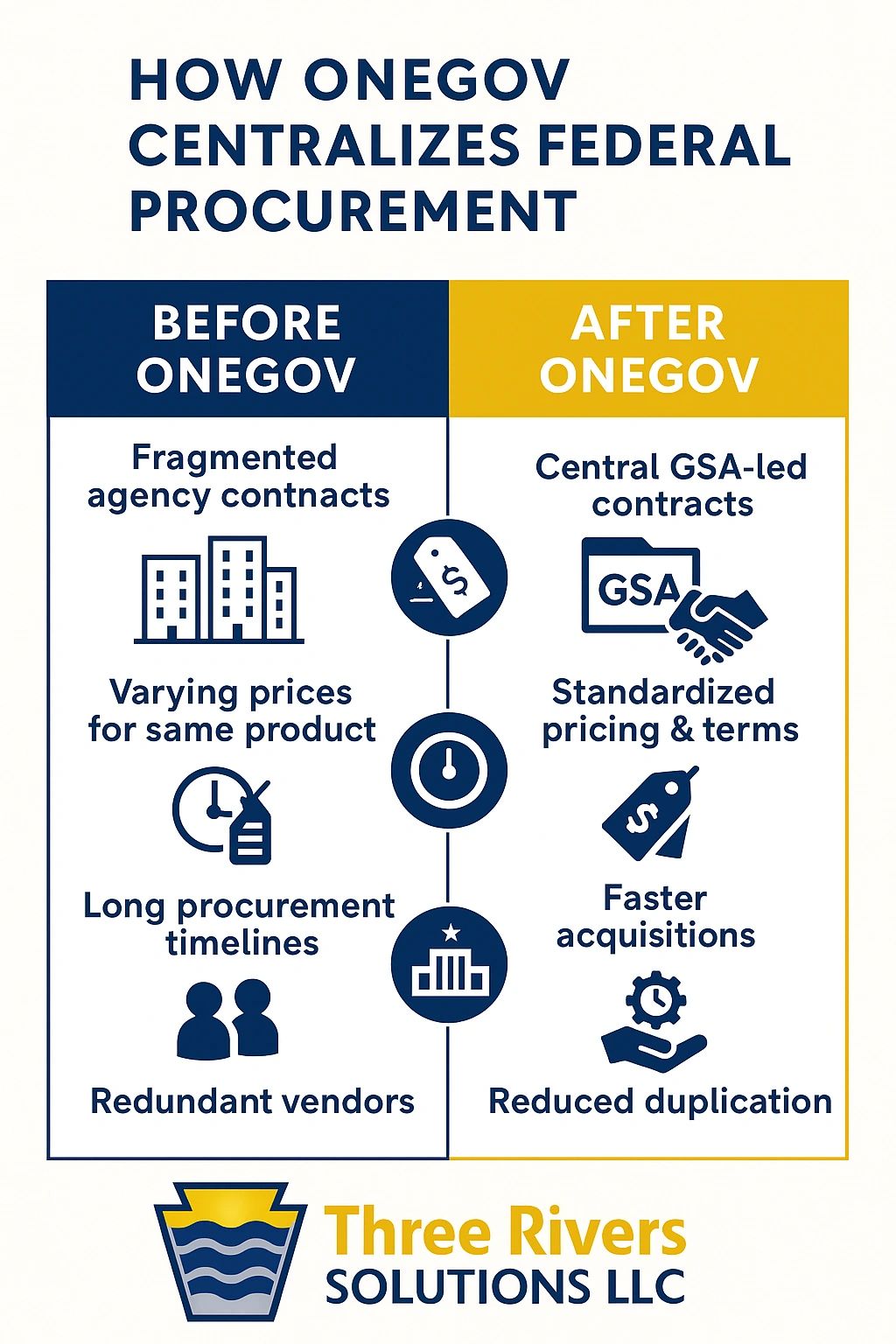
When GSA announced the OneGov strategy on April 29, 2025, the idea was simple: the federal government should buy common technology as one customer instead of hundreds of separate ones. The first phase covered commercial software, with GSA negotiating directly with the companies that make the products rather than leaving every agency to work through resellers on its own. GSA said later phases would reach hardware, platforms, infrastructure and cybersecurity services.
OneGov did not come out of nowhere. Executive Order 14240, signed March 20, 2025, directed agencies to move the buying of common goods and services to GSA and made the GSA Administrator the executive agent for governmentwide IT acquisition contracts. A few weeks later, Executive Order 14271 pushed agencies toward commercial solutions. OneGov is how GSA put those orders into practice for technology.
Where it stands now
The numbers GSA reports have grown quickly. In April 2026, GSA said OneGov saved $1.1 billion in its first year across 20 agreements with major vendors. By September 2026, GSA put the total at about $1.68 billion, with roughly $1.4 billion coming from AI agreements. Participating companies now number about two dozen and include Adobe, Google, Microsoft, OpenAI and ServiceNow.
Two points are worth keeping in mind when reading those figures. First, the savings are GSA's estimates, measured largely against commercial list prices. Second, many of the early deals were limited-time discounts, some as deep as 70 to 90 percent, set to expire on fixed dates. GSA officials have described them as a first step toward longer-term direct contracts, not the finished product. The newest agreements show where that is heading: GSA's September 2026 deal with OpenAI is a 27-month, consumption-based offer set to take effect October 1, 2026.
GSA has also said it is looking at extending OneGov beyond software to other products and services the participating companies sell.
What this means for contractors
If you sell commercial technology to the government, OneGov changes who you are negotiating with. The government increasingly wants to deal with the original manufacturer on price and terms, then let agencies buy through existing channels such as resellers on the GSA Schedule. Resellers still have a role, but the value they add has to be something other than access.
Watch the expiration dates. As the early discounts lapse, GSA is deciding which agreements to renew and on what terms. That is a window for companies that are not yet in OneGov to make their case, and a risk for those whose deals end without a renewal.
If you are not a technology company, pay attention anyway. The executive order behind OneGov covers common goods and services generally, and GSA has said it wants the strategy to reach beyond IT.
What this means for agencies
Agencies get standardized terms and pre-negotiated pricing without running their own procurements. The tradeoff is less room to tailor. Programs with real mission-specific needs should document them early, before an enterprise agreement becomes the default answer.
Three Rivers Solutions advises companies and agencies on federal procurement strategy. To talk through what OneGov means for your business, contact PBH@ThreeRiversSolutionsLLC.com.
Sources
GSA news release, "GSA Unveils OneGov Strategy," April 29, 2025.
Executive Order 14240, "Eliminating Waste and Saving Taxpayer Dollars by Consolidating Procurement," March 20, 2025.
Executive Order 14271, "Ensuring Commercial, Cost-Effective Solutions in Federal Contracts," April 2025.
GSA news release, "OneGov Saves Taxpayers $1.1 Billion in First Year," April 29, 2026.
GSA news release on the OpenAI OneGov agreement, September 10, 2026.