
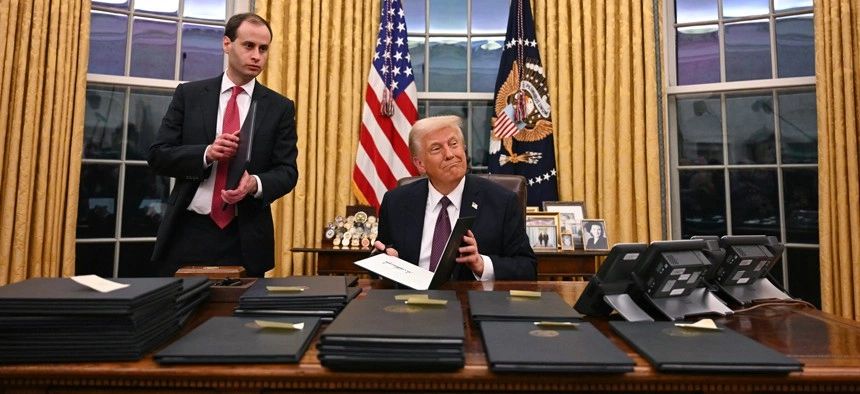
Artificial intelligence stands as the defining frontier of the 21st century, a technological race where global powers vie for supremacy. As nations like China pour resources into AI to challenge American dominance, the United States must respond with boldness and clarity. On January 23, 2025, President Trump did just that, signing Executive Order 14179, “Removing Barriers to American Leadership in Artificial Intelligence.” This decisive act dismantles bureaucratic shackles, unleashing American ingenuity to secure economic competitiveness and national security—core tenets of the Trump administration’s agenda. Swiftly following this directive, the Office of Management and Budget (OMB) issued two landmark memoranda on April 3, 2025: M-25-21, “Accelerating Federal Use of AI through Innovation, Governance, and Public Trust,” and M-25-22, “Driving Efficient Acquisition of Artificial Intelligence in Government.” Together, these policies forge a robust framework, empowering federal agencies to adopt AI with purpose and creating a vibrant marketplace for U.S. contractors. This essay delves into their intricacies, explores their strategic implications, and charts a course for Senior Federal Executives and contractors to seize this transformative moment.
EO 14179: A Foundation for American Ingenuity
EO 14179 marks a rejection of the cautious, regulation-heavy approach of Executive Order 14110, which it revokes, signaling a shift toward a government that enables rather than impedes. By mandating a review of prior AI policies and an action plan due by July 22, 2025, the order aims to eliminate barriers that stifle innovation, ensuring the U.S. retains its technological edge. This is a strategic realignment, prioritizing American leadership in a field critical to future prosperity and defense. For agencies, it offers freedom to harness AI for public good; for contractors, it’s an invitation to partner in building a U.S.-centric AI ecosystem. The OMB memoranda translate this vision into practice, providing the detailed guidance needed to turn ambition into action.
M-25-21: Accelerating AI Adoption with Purpose
M-25-21, supplanting M-24-10, emerges as the engine of this strategy, urging agencies to embrace AI across innovation, governance, and public trust. Covering all executive branch entities under 44 U.S.C. § 3502(1), with specific mandates for Chief Financial Officers Act agencies, it drives a comprehensive push for adoption. Its call for AI strategies by September 30, 2025, requires agencies to articulate use cases and maturity plans, fostering breakthroughs like cross-agency data sharing that could revolutionize service delivery—think faster disaster response through predictive analytics. This aligns with Trump’s efficiency focus, reducing redundancy and amplifying impact.
The innovation mandate is bold: agencies must share AI code and models government-wide, maximizing taxpayer value, while prioritizing U.S.-developed solutions—a move that bolsters domestic industry and national security. Workforce readiness is equally critical, with OMB and GSA training programs set to equip staff for this shift. Governance is fortified by requiring CAIOs by June 2, 2025, and AI Governance Boards by July 2, 2025, ensuring coordinated leadership. By December 29, 2025, agencies must update policies, including generative AI rules, reflecting a proactive stance on emerging tech.
Public trust hinges on managing “high-impact” AI—systems affecting rights or safety—via risk practices due by April 3, 2026, like testing and assessments, with transparent waiver reporting. This balance of innovation and accountability reflects Trump’s pragmatic approach. Executives should appoint a CAIO by June 2, 2025, and request OMB’s training schedule by May to prepare staff—imagine a CAIO pitching an AI fraud-detection tool to streamline audits. Contractors can offer U.S.-made platforms, but resource constraints may challenge agencies; phased implementation can mitigate this. By early 2026, contractors should provide testing protocols to meet compliance demands.
M-25-22: Streamlining Procurement for Efficiency
Where M-25-21 fuels adoption, M-25-22, replacing M-24-18, ensures agencies acquire AI effectively, applying to contracts post-October 1, 2025. It champions competition by preventing vendor lock-in through interoperable solutions, spurring a dynamic marketplace that could drive down costs and accelerate innovation—a Trump free-market win. Favoring U.S.-developed AI via broad research, supported by OMB playbooks, it strengthens domestic tech leadership.
Risk management is rigorous: quarterly performance tests and PII/IP protections, due in policies by December 29, 2025, safeguard value and sovereignty. Transparency in high-impact AI solicitations demands contractor diligence. Cross-functional teams, aided by GSA guides (July 12, 2025) and a repository (October 20, 2025), ensure robust procurement. Executives should revise policies by December 29, 2025, and request GSA’s guide by July to craft solicitations—picture a team testing a security AI in agency networks by mid-2025. Contractors must offer U.S.-built, open-API solutions, but pricing transparency pressures may arise; fixed-rate contracts can ease this. Testing sandboxes post-October 1, 2025, will solidify their role.
Contractors can differentiate by emphasizing scalability—imagine pitching a platform that grows with agency needs—aligning with Trump’s cost-efficiency goals and avoiding lock-in pitfalls.
Synergy of EO 14179 and OMB Memoranda: A Coordinated Framework
EO 14179 and the OMB memoranda form a seamless strategy. The order’s barrier removal, with its July 22, 2025, action plan, sets the stage for M-25-21’s adoption push—CAIOs by June 2, 2025, strategies by September 30, 2025, and risk management by April 3, 2026—and M-25-22’s procurement efficiency, effective October 1, 2025, with updates by December 29, 2025. This framework optimizes efficiency, leveraging U.S. technology to enhance services and security. Executives should meet deadlines, using GSA resources (e.g., the July 12 guide) to collaborate, while contractors align with interoperable standards, engaging by June 2025 to shape strategies and compliance.
Seizing the AI Edge
M-25-21 and M-25-22, rooted in EO 14179, position agencies and contractors to lead an AI revolution. The Trump administration envisions a future of smarter cities, stronger defenses, and thriving industries—all powered by American innovation. Act by June 2, 2025, to shape this legacy. The U.S.’s technological edge awaits those bold enough to claim it.
At Three Rivers Solutions, LLC, we are dedicated to helping organizations navigate this evolving landscape.