
The federal government is attempting to simplify acquisition through a transition that may temporarily make procurement more complicated.
That is the central challenge facing federal contractors as the Revolutionary Federal Acquisition Regulation Overhaul moves from regulatory rewriting into workforce implementation and formal rulemaking.
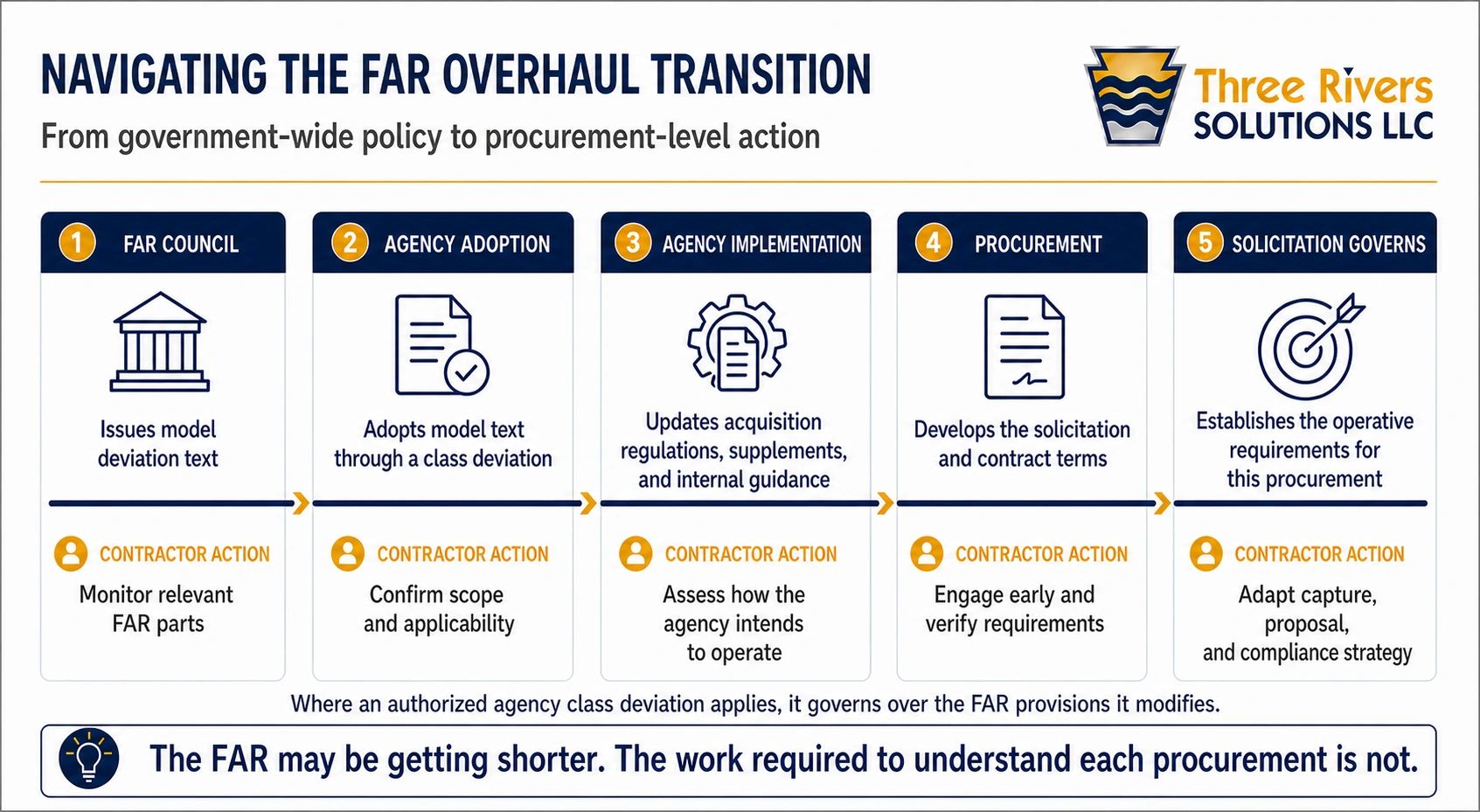
The government has issued rewritten Federal Acquisition Regulation parts as model deviations, encouraged agencies to adopt them through class deviations, developed new practitioner guidance, and begun converting the temporary framework into permanent regulation. At the same time, acquisition professionals are being trained to exercise greater judgment under a less prescriptive system.
Each component is intended to support faster and more effective acquisition. Together, however, they create a period in which governing requirements, acquisition practices, and workforce adoption may vary by agency and procurement.
For contractors, the overhaul is more than a compliance event. It is also a market-intelligence, capture, and government-engagement event.
The overhaul has entered its real test
The initiative implements Executive Order 14275, Restoring Common Sense to Federal Procurement, and Office of Management and Budget Memorandum M-25-26, Overhauling the Federal Acquisition Regulation.
Led by the Office of Federal Procurement Policy and the Federal Acquisition Regulatory Council, the overhaul is intended to return the FAR to its statutory foundation, remove unnecessary mandates, rewrite requirements in plain language, and restore discretion to the acquisition workforce.
The government moved quickly through the initial deviation process. Rewritten FAR parts were issued as model text, agencies began adopting that text through class deviations, and nonregulatory resources were developed to help acquisition professionals apply the streamlined framework.
Now comes the more difficult phase.
The government must institutionalize the changes across a workforce that includes contracting officers, program managers, agency counsel, policy officials, and other acquisition professionals with different levels of experience, risk tolerance, and familiarity with the new approach. At the same time, the FAR Council is conducting formal notice-and-comment rulemaking to convert the deviation framework into permanent regulation.
The official RFO Frequently Asked Questions describe the period between agency adoption of model deviation text and rulemaking as a “testing period.” Acquisition teams are applying the rewritten text and nonregulatory guidance to actual procurements, testing new approaches, and reporting implementation results.
The government is not simply publishing a completed new rulebook. It is learning how the new system works while using it.
Simpler rules will not immediately produce uniform practices
The overhaul is designed to reduce unnecessary regulatory prescription. In principle, this should make it easier for acquisition professionals to focus on mission requirements, commercial practices, competition, speed, and measurable outcomes.
But reduced prescription changes the contractor’s challenge.
Under a highly prescriptive system, companies devote significant effort to understanding detailed government-wide procedures. Under a more discretionary system, they must devote greater effort to understanding how a particular agency, contracting office, and acquisition team intends to exercise its judgment.
Those are not the same capability.
A contracting officer may continue using a practice removed from the FAR because it remains permissible and useful. Another may adopt a more streamlined approach informed by the FAR Companion or a practitioner album. A third may proceed cautiously while agency policy officials and counsel consider the implications.
The result may be meaningfully different acquisition approaches for comparable requirements, including within the same agency.
The federal government expects these differences to diminish as agencies adopt the model text, the workforce gains experience, and permanent rules take effect. During the transition, however, contractors should not assume that a government-wide policy announcement will be applied consistently in every procurement.
The model text is only one part of the governing framework
A model deviation issued by the FAR Council does not automatically govern every agency acquisition. An agency must adopt the text through its own class deviation before it applies within that agency.
For a priority opportunity, a contractor may need to evaluate several layers of authority and guidance:
- The codified FAR.
- The FAR Council’s model deviation text.
- The procuring agency’s class deviation.
- The agency’s acquisition regulation or supplement.
- The provisions and clauses in the solicitation.
- Nonregulatory guidance that may influence the acquisition team’s approach.
These materials are related, but they are not interchangeable. Where an agency has issued an authorized class deviation, that deviation governs over the FAR provisions it modifies within its stated scope and period of applicability. The codified FAR continues to govern where the deviation does not apply.
The FAR Companion, practitioner albums, buying guides, training materials, and other Strategic Acquisition Guidance resources can help acquisition professionals apply the streamlined framework. They do not carry the same authority as regulations, deviations, or solicitation terms.
Their practical influence may nevertheless be significant. These resources can shape how an acquisition team conducts market research, structures competition, develops an evaluation approach, or exercises discretion.
Likewise, the removal of a procedure from the FAR does not necessarily prohibit an acquisition team from continuing to use it. Contractors should not treat deletion from the FAR as either an automatic compliance exemption or a guarantee that established agency practices will immediately change.
Contractors should ask two separate questions:
- What requirements govern this procurement?
- What practices are likely to shape how the acquisition team conducts it?
A traditional compliance review may answer the first question. Effective capture and agency intelligence are needed to answer the second.
This is a capture issue, not only a contracts issue
Companies that treat the overhaul solely as a legal or contracts-management matter will miss an important part of the transition.
Changes involving market research, commercial acquisition, acquisition planning, contract types, simplified procedures, and small-business participation may affect agency decisions well before a solicitation is released.
Capture teams should revisit assumptions inherited from prior procurements. An agency may conduct market research differently, use a different contract structure, simplify an evaluation method, or place greater emphasis on commercial solutions. A strategy based entirely on the prior competition may no longer reflect the agency’s available options or current thinking.
For a major opportunity, useful intelligence may include whether an agency has incorporated its class deviation into procurement templates and contract-writing systems, whether policy officials and counsel have approved a new acquisition approach, and whether the program office intends to retain familiar procedures that are no longer mandatory.
This makes early, authorized engagement more valuable.
Requests for information, draft solicitations, industry days, one-on-one meetings, and other permissible exchanges can help contractors understand how an agency is interpreting the new framework. They also give industry an opportunity to identify language that could restrict competition, create implementation problems, or conflict with commercial practice.
Small businesses should pay particular attention to changes involving market research, acquisition planning, set-aside analysis, and simplified acquisition procedures. Greater procedural flexibility may create competitive openings, but it may also affect how an agency evaluates the availability of capable small-business sources. Early engagement supported by specific evidence of capabilities, capacity, and past performance will remain important.
The government has demonstrated that industry input can matter. According to the FAR Council’s “You Said, We Did” initiative, the model deviations generated nearly 1,600 comments, approximately 80 percent from industry. The initiative identifies examples of changes made as that feedback informed the proposed rules.
Effective engagement should be specific, operationally grounded, and connected to acquisition outcomes. Contractors should explain the practical consequence of a provision, support the concern with evidence, and recommend workable language.
GSA illustrates the layered implementation challenge
The General Services Administration offers an important early example because it is participating in the government-wide FAR overhaul while also revising its own acquisition framework.
GSA has launched a separate General Services Administration Acquisition Regulation overhaul. Regulatory material affecting contractors and offerors remains in the GSAR, while nonregulatory internal policy has been separated into the GSA Acquisition Handbook.
For a GSA contractor, the relevant environment may therefore include the codified FAR, an RFO model deviation, GSA’s class deviation, the revised GSAR, the solicitation or contract, and nonregulatory guidance influencing internal acquisition practice.
The distinction is more than technical. Internal guidance may shape how GSA plans a procurement, conducts market research, communicates with industry, or evaluates acquisition options even when that guidance does not impose a direct obligation on an offeror.
Contractors pursuing GSA Schedule and OASIS+ opportunities should monitor how the revised FAR and GSAR framework appears in solicitations, task-order competitions, modifications, and related acquisition practices. The effect will depend on the governing solicitation or contract language and the specific deviation being implemented.
Understanding the regulatory text is necessary. Understanding how the agency is using it is a competitive advantage.
Five actions contractors should take now
Federal contractors do not need to create a large new bureaucracy around the overhaul. They do need a focused operating process.
1. Map the governing framework for priority opportunities
Select the company’s most important pipeline opportunities. Identify the relevant FAR parts, applicable agency deviations, agency supplements, material solicitation provisions and clauses, and any unresolved interpretation questions.
2. Test existing capture assumptions
Determine which acquisition assumptions come from a prior competition and which have been validated for the current procurement. Pay particular attention to contract type, evaluation method, market research, commerciality, and small-business strategy.
3. Add deviation verification to bid reviews
Before major bid decisions and proposal submission, require contracts or legal personnel to confirm which agency deviations apply and whether they materially change legacy FAR requirements or established proposal assumptions.
4. Review reusable proposal content
Examine compliance matrices, clause citations, representations, certifications, and descriptions of government procedures for outdated references. Do not remove legacy content automatically. Determine whether it remains required, permissible, or strategically useful.
5. Assign agency-specific ownership
Connect regulatory monitoring to named agencies and opportunities. General policy summaries have limited value if no one is responsible for translating them into capture decisions, engagement priorities, and proposal actions.
The competitive question is how agencies will use the new flexibility
The overhaul’s objectives are significant: fewer unnecessary mandates, clearer regulations, greater competition, lower barriers to entry, and better acquisition outcomes. Whether those benefits are realized will depend on implementation at the agency and procurement levels.
Contractors should support the goal of a simpler acquisition system while remaining clear-eyed about the transition. Less regulatory prescription may reduce some burdens, but it also increases the importance of contracting-officer judgment, agency intelligence, early engagement, and procurement-specific analysis.
The companies best positioned for this environment will not be those that merely know the new text. They will be those that understand how agencies are interpreting it, where implementation remains unsettled, and how to align credible solutions with the government’s expanded acquisition flexibility.