The FAR's Commercial Preference Gets Real Teeth
Federal procurement has said it wants to buy commercial for thirty years now. The Federal Acquisition Streamlining Act set that direction back in 1994, and every few years an executive order or a policy memo comes along to restate it. What hasn't moved much, until this release, is the part of the Federal Acquisition Regulation (FAR) that actually governs how a commercial buy gets structured and priced.
On September 18, the FAR Council published four proposed rules under the Revolutionary FAR Overhaul (RFO), covering sixteen more parts of the regulation. Most of it is what you'd expect from a release like this: reorganized text, plain-language edits, "shall" swapped out for "must." But two changes, tucked into FAR Case 2026-003 and FAR Case 2026-006, go further than that. Both change how the government structures commercial acquisitions, and if you sell commercial products, services, or software to federal agencies, both are worth your attention.
The Clause Burden Shifts to the Government
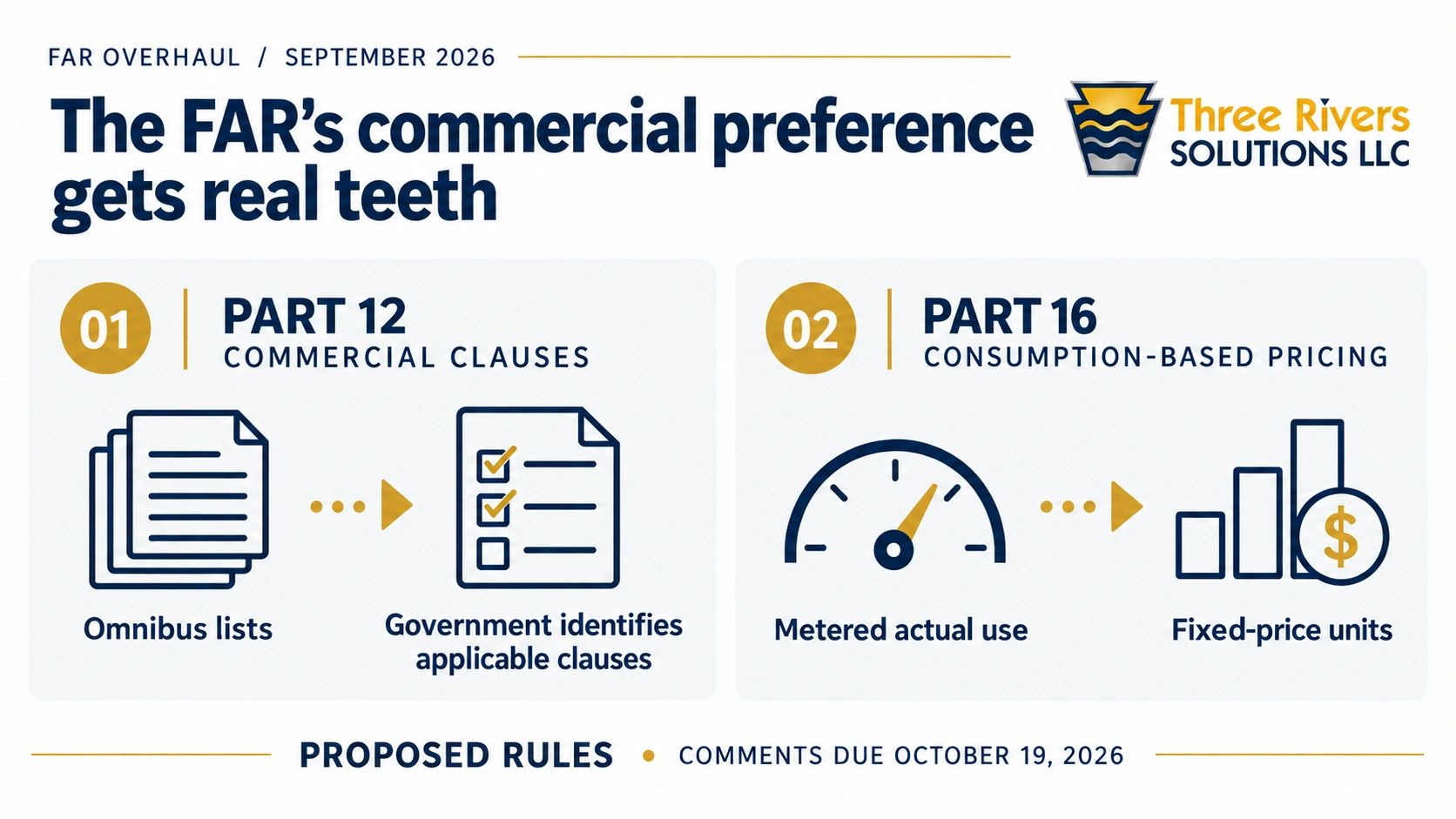
Commercial acquisitions have leaned on two catch-all mechanisms since the mid-1990s: FAR 52.212-3, the offeror representations and certifications provision, and FAR 52.212-5, which covers statutory and executive-order terms and conditions. Think of them as running lists of everything that might apply to a given buy. The catch is the FAR Council's own preamble admits those lists have never been complete, which has left offerors to figure out on their own what actually applies to their contract.
The proposed rule gets rid of both provisions. What's left at FAR 12.205 is a much shorter list: instructions to offerors, evaluation criteria, and one consolidated terms-and-conditions clause. If a contracting officer wants something beyond that, they now need an agency deviation under FAR Part 1 to get it. Today, a contracting officer can reach into the omnibus list whenever it seems relevant. Under the proposed rule, that discretion gets a lot narrower.
What this really does is flip who's on the hook for figuring out compliance. Offerors have spent years sorting through an incomplete list after the fact. Now that job falls to the government up front, and if it wants to add something beyond what's on the list, it has to justify it.
A Contract Type for Consumption-Based Pricing
The second change lives in FAR Part 16, and it fixes something that's been a headache for commercial tech contracting for a while: the FAR never had a clean way to write a usage-based contract.
A cloud subscription just doesn't fit a traditional fixed-price supply contract, and it doesn't fit cost-reimbursement either. So agencies have worked around it, structuring these buys as Indefinite Delivery/Indefinite Quantity (IDIQ) contracts with estimated quantities, or negotiating something closer to time-and-materials. Neither one is really a good fit.
The proposed rule closes that gap. Implementing section 1825 of the fiscal year 2026 National Defense Authorization Act (NDAA), it directs the FAR to define a "consumption-based solution" and treat supplies and services that are metered and billed on actual usage, priced as fixed-price units, as firm-fixed-price contracting. That's a change to the contract-type classification itself, not just a new clause bolted onto an old structure, and it has real consequences for cost accounting standards and how a termination for convenience gets priced.
Worth reading the definition closely before you assume it covers your pricing model. It works well for straightforward per-unit metering. It has a lot less to say about tiered discounts or committed-use pricing, which is how plenty of commercial cloud vendors actually structure their deals, and the proposed rule doesn't spell out how those arrangements would be handled.
Reading the Signal
Eight of the RFO's eventual twelve FAR cases have published so far, and most of what's in them is structural. The Council could have treated Part 12's clause list and Part 16's contract-type definitions the same way. It didn't. In a release that's otherwise heavy on reorganization and plain language, choosing to make real substantive changes specifically to the mechanics of commercial buying tells you something about where the priorities are right now.
What Comes Next
Comments on this batch are due October 19, 2026. Two related pieces of the overhaul are still outstanding. FAR Case 2026-004, covering small business policy under Part 19, hasn't published yet, and it'll shape how these commercial-buying changes interact with set-aside competitions. FAR Case 2026-011 proposes lining up civilian-agency data rights with the defense acquisition regulation's framework, which is its own story for software and technical-data contractors.
The FAR's commitment to commercial buying has outlasted several administrations without much changing in the actual rule text. This is one of the places where a meaningful piece of it finally did.