
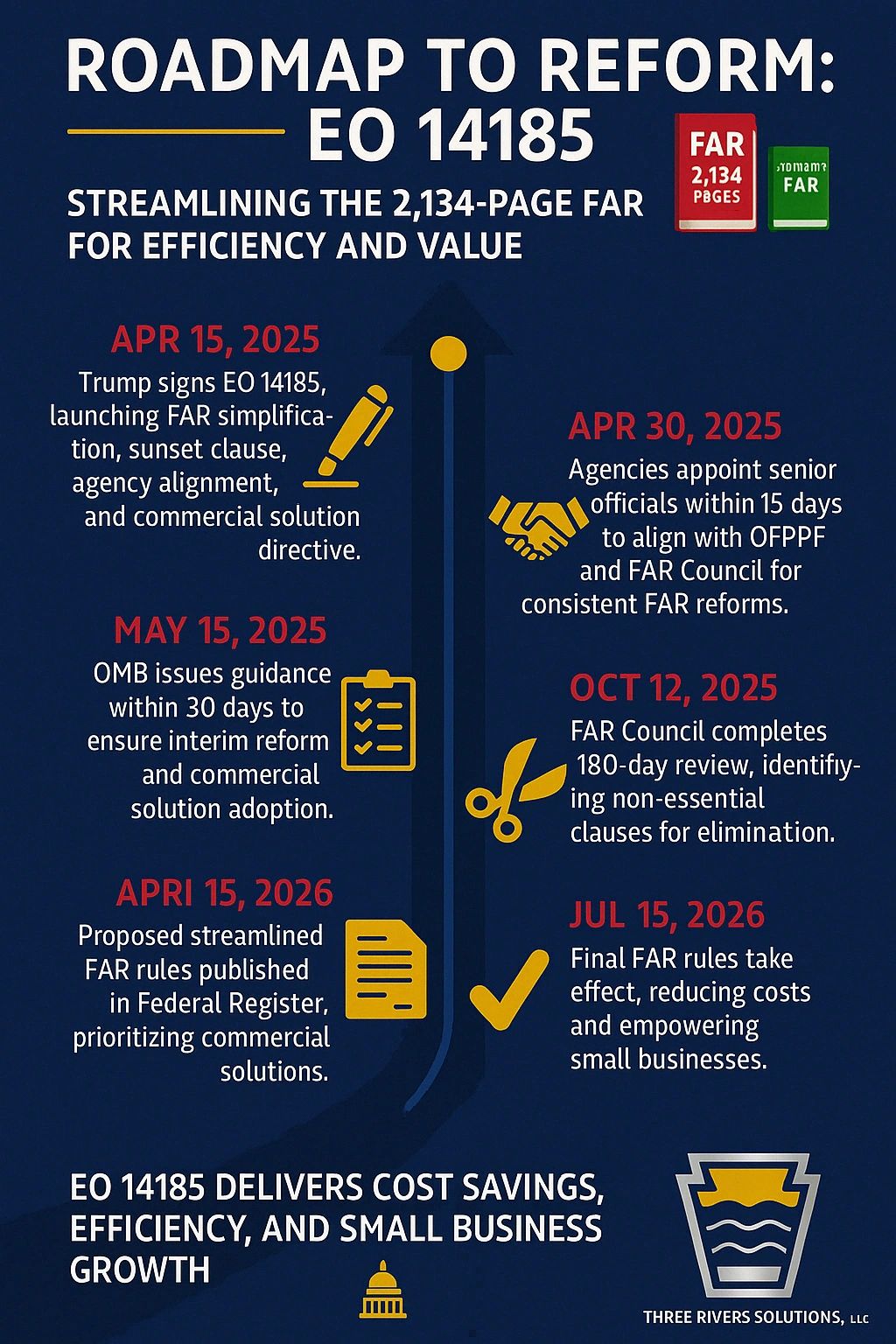
How Executive Order 14185 reshapes federal contracting and FAR compliance
On April 15, 2025, President Donald J. Trump signed Executive Order 14185, “Restoring Common Sense to Federal Procurement,” initiating a major overhaul of federal acquisition practices. This reform seeks to simplify the complex Federal Acquisition Regulation (FAR), significantly reduce regulatory burdens, enhance government efficiency, and improve overall value delivered to taxpayers.
Understanding the Federal Acquisition Regulation (FAR)
Established over 40 years ago, the FAR has expanded into a dense, over 2,000-page document governing nearly $700 billion annually in federal contracting. Critics argue that its complexity hampers efficiency, innovation, and competition, particularly disadvantaging small businesses and new market entrants who lack resources for extensive compliance.
Historically, efforts to simplify the FAR, such as the Federal Acquisition Streamlining Act of 1994, sought to reduce procurement bureaucracy and prioritize commercial off-the-shelf solutions. Despite these efforts, complexities and redundancies have continued to accumulate, prompting this new comprehensive reform.
Key Provisions of Executive Order 14185
- FAR Simplification: A comprehensive review will identify and eliminate non-essential regulatory provisions, retaining only those required by statute or vital for national security and effective procurement.
- Regulatory Sunset Clause: Non-statutory FAR clauses will automatically expire every four years unless expressly renewed, ensuring regulations remain current, necessary, and aligned with evolving procurement needs.
- Agency Alignment: Federal agencies must appoint senior officials to coordinate with the Office of Federal Procurement Policy (OFPP) and the FAR Council, ensuring agency regulations align consistently with streamlined FAR practices.
- OMB Implementation Guidance: The Office of Management and Budget (OMB) will provide immediate guidance to facilitate swift implementation and adherence to streamlined acquisition practices, reducing the risk of inconsistencies during the transition period.
Emphasis on Commercial Solutions
Alongside EO 14185, the Trump administration issued a directive emphasizing commercially available products and services. This approach requires agencies to explicitly justify when specialized, custom solutions are necessary, aiming to leverage cost-effective commercial options widely available in the marketplace. This shift intends to decrease procurement cycle times, reduce costs, and foster innovation by tapping into commercial-sector expertise.
Potential Impact and Benefits
This comprehensive reform is expected to yield significant benefits:
- Cost Savings: Streamlined regulations and increased competition could substantially lower the federal government's procurement costs.
- Efficiency: Reducing bureaucratic hurdles will shorten procurement timelines, enabling quicker responses to emerging needs and crises.
- Innovation: Encouraging commercial solutions will bring more innovative and efficient technologies and practices into federal agencies.
- Small Business Empowerment: Easier and more transparent procurement processes will facilitate increased participation from small and medium-sized enterprises, promoting economic growth and job creation.
Historical Context and the Rationale Behind Rescinding Previous Executive Orders
The 2025 procurement reform explicitly revokes several Biden-era executive orders, each of which introduced requirements perceived by the Trump administration as detrimental to procurement efficiency and competition:
Executive Order 14005 – Buy American Strengthening
EO 14005, signed on January 25, 2021, required federal agencies to prioritize American-made products, creating the Made in America Office to oversee compliance. While promoting domestic manufacturing, the Trump administration argues this approach often resulted in higher costs, delays, and reduced flexibility, particularly where domestic alternatives were limited or significantly more expensive. Rescinding EO 14005 restores agency flexibility, balancing domestic preference with practical and cost-effective procurement decisions.
Executive Order 14030 – Climate-Related Financial Risk
EO 14030, enacted on May 20, 2021, mandated that agencies integrate climate risk assessments into procurement. While environmentally focused, the Trump administration believes these mandates created substantial bureaucratic overhead and diverted attention from primary agency missions. By eliminating these additional requirements, agencies can streamline their procurement processes and refocus resources directly on their mission-critical operations.
Executive Order 14063 – Project Labor Agreements (PLAs)
EO 14063 required federal construction projects above $35 million to use project labor agreements with unions. While intended to ensure labor stability, the Trump administration argues mandatory PLAs limited competition by deterring non-union contractors, often leading to inflated costs and project delays. Rescinding EO 14063 aims to restore open competition, reduce costs, and accelerate project timelines.
Executive Order 13985 – Advancing Racial Equity
EO 13985, issued on January 20, 2021, directed agencies to integrate equity-focused assessments into procurement to address historical barriers. While the intent was to foster equity, the Trump administration believes these additional evaluation criteria complicated procurement processes, increased costs, and diluted the principle of merit-based competition. By rescinding EO 13985, the Trump administration aims to simplify bidding, reduce compliance burdens, and ensure awards focus strictly on capability, quality, and cost-effectiveness.
Looking Forward
Successful implementation of these procurement reforms relies on effective coordination among federal agencies, the FAR Council, OFPP, and OMB. Contractors and federal officials alike must adapt quickly to the evolving landscape, emphasizing flexibility, innovation, and efficiency. The Trump administration’s reforms promise a streamlined, responsive procurement system, better positioned to deliver value to taxpayers and support a competitive, dynamic business environment.
At Three Rivers Solutions, LLC, we are dedicated to helping clients navigate this evolving landscape.
Alongside EO 14275, the Trump administration issued a directive emphasizing commercially available products and services. This approach requires agencies to explicitly justify when specialized, custom solutions are necessary, aiming to leverage cost-effective commercial options widely available in the marketplace. This shift intends to decrease procurement cycle times, reduce costs, and foster innovation by tapping into commercial-sector expertise.